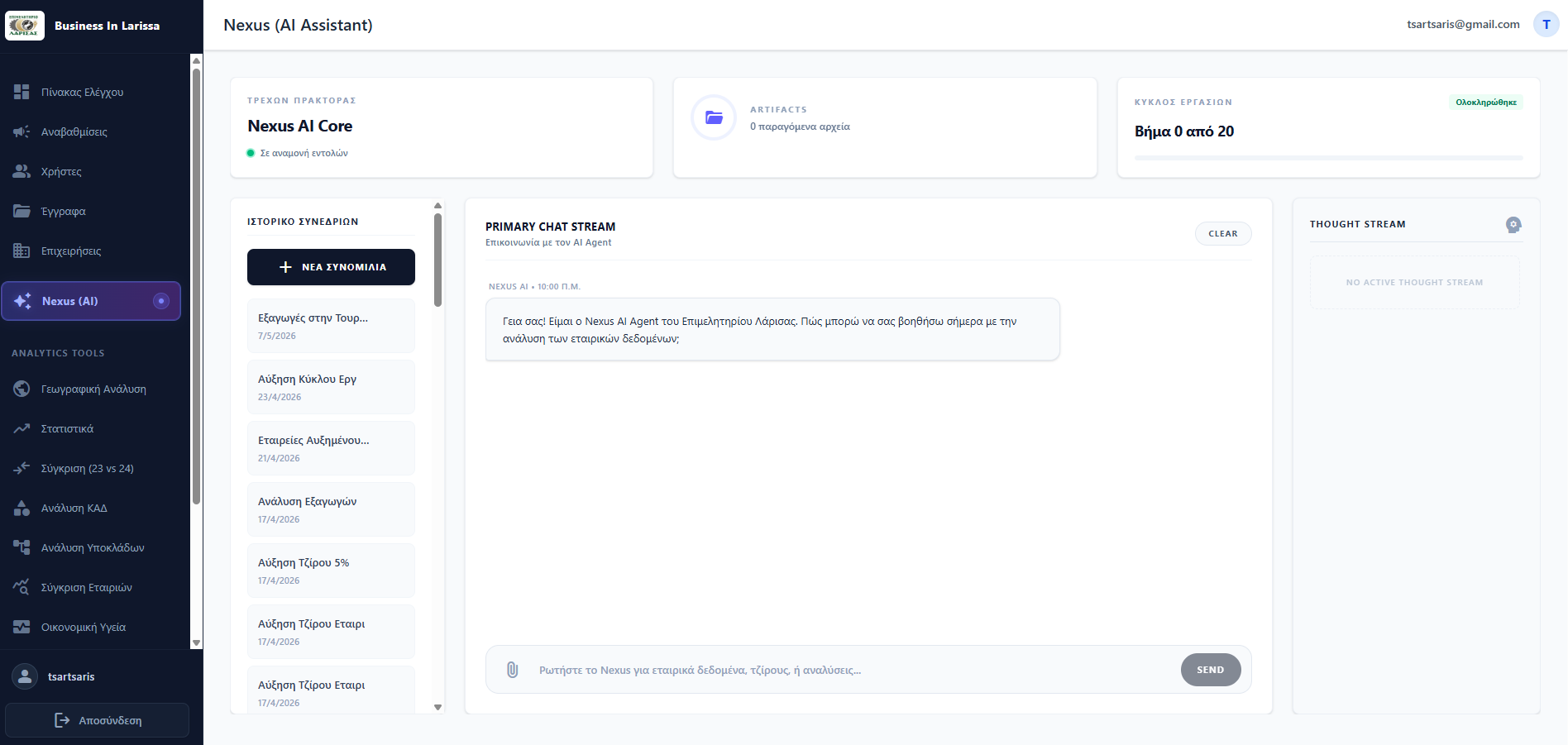
A single AI model answering questions from a database is a gamble: you either trust it blindly or you don’t use it at all. Nexus, the AI system inside Business in Larissa, was built to remove that gamble by splitting the job across specialized agents and showing its work as it goes.
This is the follow-up to our chamber of commerce software case study on the Larissa Chamber platform. That post covered getting scanned filings into structured data. This one covers what happens once a chamber’s staff want to actually ask that data questions.
Why one AI model isn’t enough
A financial database is not a place for a single language model to freelance. Ask it to “find the most profitable exporters” and a model working alone has to silently decide what “profitable” means, write its own query, and hope the numbers it returns are right, with no way for a chamber employee to check any of that.
Nexus solves this by never letting one model do the whole job. Instead, a chamber of commerce AI agents architecture splits the work: one agent decides what needs to happen, dedicated agents execute it, and the first agent reviews the result before deciding what happens next.
How the agents divide the work
At the center is an Orchestrator, which reads the conversation and routes each turn to exactly one specialist:
SQL Agent translates a plain-language question into a live, read-only database query, restricted to an explicit allowlist of tables and to SELECT statements only, so it can retrieve but never alter chamber data.
Data Solver reasons over data already retrieved in the conversation, producing analysis and explanation rather than re-querying the database unnecessarily.
Chart Analytics Engineer turns numeric results into structured chart specifications, rendered live as bar, stacked-bar, pie, or scatter visualizations.
Report Synthesizer compiles an entire session into a formatted PDF report, with charts embedded exactly where they belong in the analysis, ready to download or share internally.
The Orchestrator reviews each agent’s output. It then decides if the answer is complete or if another agent should run. The system also includes anti-loop logic. This prevents it from repeatedly querying the same agent.
Watching the reasoning happen
Most AI assistants are a black box: a question goes in, an answer comes out, and there’s no way to see what happened in between. Nexus exposes that middle step directly. A live “Thought Stream,” delivered over a WebSocket connection, shows which agent is active and a short account of what it’s doing (querying the database, building a chart, drafting a report) as it happens.
Chambers often handle sensitive financial data for their member companies. For them, visibility is not optional. It is essential. This transparency lets them trust the system’s output. They no longer need to treat it as a black box and double-check everything manually.
Conversations that don’t lose the thread
Nexus keeps a full session history for every user. Users can browse it easily from a sidebar. The system also generates a short, relevant title for each new conversation. It creates this title from the user’s first question. Long-running conversations don’t degrade either. Once a session reaches a certain length, the system automatically compresses older messages into a running summary behind the scenes. This allows the assistant to maintain a clear understanding of the entire discussion without the context ever overflowing.
Built with guardrails, not just capability
A few design choices matter more than they might look at first glance: – The database connection the SQL Agent uses is read-only at the connection level, not just by instruction, a second layer of protection beyond the prompt. – Only a fixed set of financial tables is exposed to the agent; nothing outside that scope is reachable. – Response language follows the chamber’s own working language, with the SQL Agent specifically instructed to answer in Greek. – Which underlying model powers each agent is configurable per organization, so the platform isn’t locked to a single AI provider.
Why this matters for chambers of commerce
The first post on Business in Larissa covered turning scanned filings into structured, queryable data. Nexus is what a chamber’s own staff get once that data exists: a system that answers financial questions directly, builds the chart to go with the answer, and shows its reasoning well enough to trust, without needing anyone on staff to write a query themselves.
If your chamber is evaluating what “AI on top of your data” should look like in practice, this is the solution. We built these chamber of commerce AI agents to show their reasoning step by step, not just deliver final answers. This version is designed to be checked and verified, not simply believed.
Deploy Nexus OMAS in your organisation.
A 30-minute architecture briefing, we map your data landscape and tell you honestly whether OMAS is the right fit.