Building Chamber of Commerce Software: The Business in Larissa Case Study
Chambers of commerce across Greece sit on a strange kind of goldmine. Every member company files financial statements, trade declarations, and registry updates year after year. But that data usually lives scattered across PDFs, spreadsheets, and paper archives, disconnected from any system that can actually use it. The Larissa Chamber of Commerce came to us with exactly this problem. And we built dedicated chamber of commerce software to solve it: a platform that turns raw member filings into a searchable, analyzable picture of the local business community.
We call the result Business in Larissa. Built on Nexus OMAS, our platform for regulated professional-services and public-sector organizations. If your chamber, association, or registry office is sitting on the same kind of trapped data, continue reading.
Why chambers of commerce need this kind of software
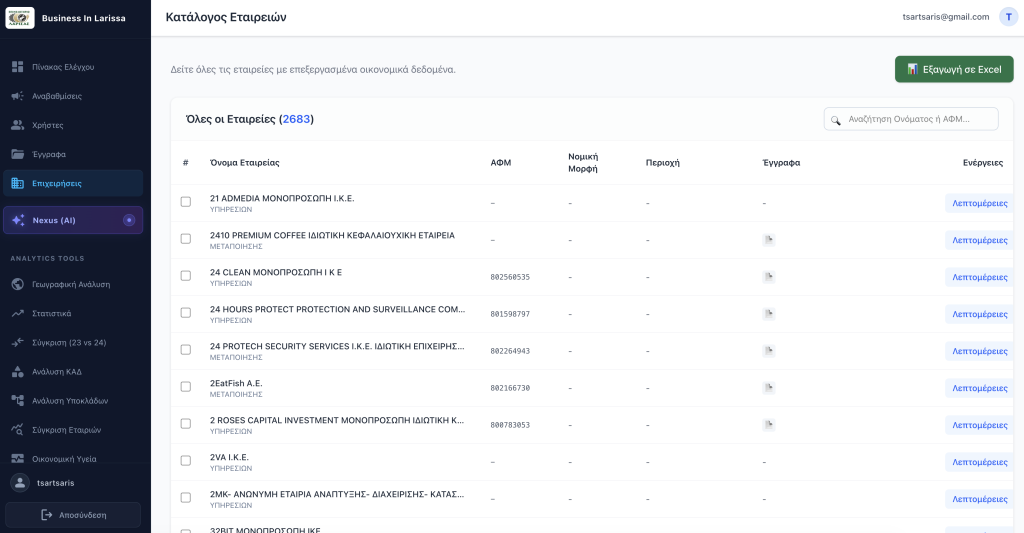
Most chambers don’t lack data; they lack a way to use it. Financial statements filed with a chamber typically arrive as PDFs, often scanned, often in local accounting formats that don’t map to any off-the-shelf software template. Before any analysis can happen, that data has to get out of the PDF and into a structured, queryable form: company name, tax number, registry number, balance sheet line items, employee counts, correctly separated by fiscal year.
Doing this by hand doesn’t scale past a few dozen companies. A chamber with a full regional business registry needs a business registry data platform that can process filings at volume without a data-entry team behind it.
Turning member filings into structured data
The extraction pipeline combines two things deliberately kept separate: text extraction and interpretation. The system parses documents to pull raw text and tables, including a check for a specific failure mode we ran into early: broken font encoding that duplicates characters in scanned Greek text (turning “Κέρδος” into “ΚΚέέρρδδοοςς”). Catching that before it reaches the extraction step avoids silently corrupted data downstream.
The structured extraction itself uses an AI extraction model, which we prompt to return a single JSON object mapping local accounting terms to standard fields, with company identifiers (tax number, registry number, company name) treated as mandatory: if the system cannot find any of those, it flags the extraction as a failure rather than accepting it with gaps. The system normalizes numeric fields to remove currency symbols and enforce a consistent decimal format, and automatically maps each statement to the correct fiscal year.
Staff can process filings individually as they arrive, or run them through in batch, so a chamber can work through years of historical archives rather than only new submissions.
Keeping company records clean
Company registries drift over time: the same business can end up with multiple records due to renaming, address changes, or duplicate filings. Business in Larissa includes a merge tool that lets an admin combine two company records into one, moving all associated documents and financial history to the surviving record and cleanly retiring the duplicate. Company location and registry details can be corrected directly, and the platform recalculates financial ratios automatically whenever underlying data changes.
Making member data useful
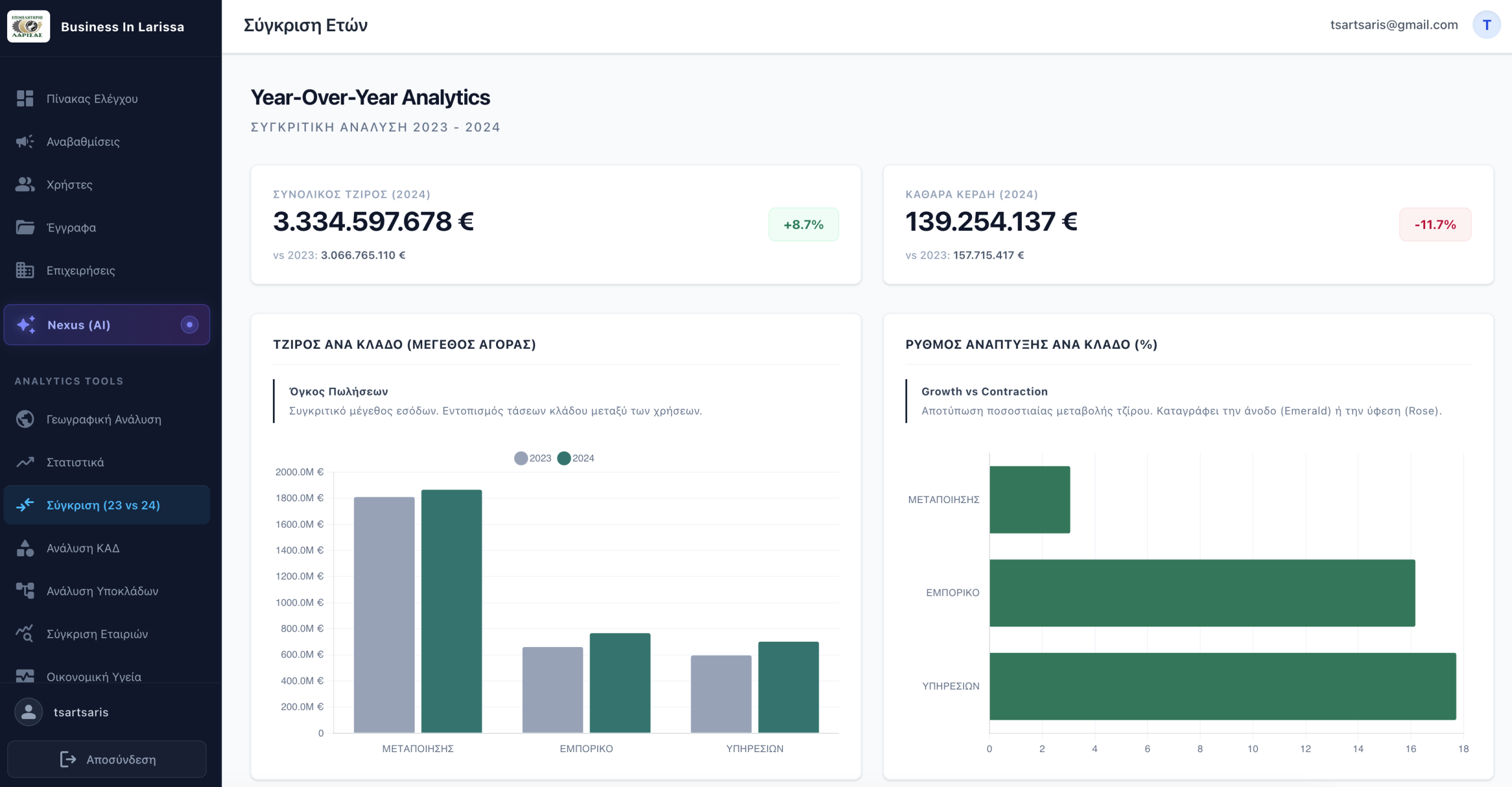
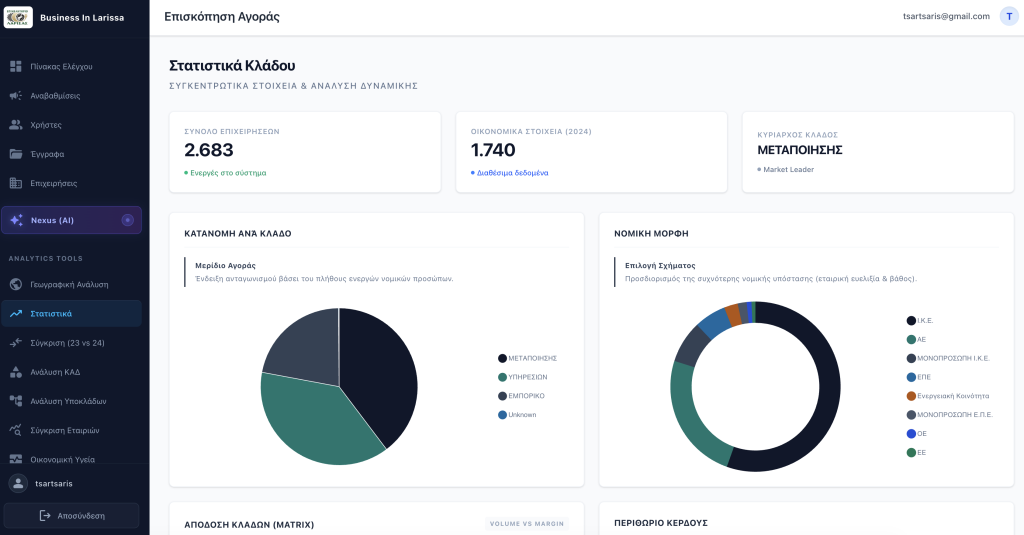
Once filings are structured, the platform turns them into analytical views built specifically for what a chamber of commerce cares about:
- Industry and sub-industry breakdowns: performance grouped by standard business activity classification (KAD in Greece, comparable codes elsewhere)
- Financial health scoring: companies grouped into tiers (strong, stable, vulnerable, distressed) based on profitability, liquidity, and leverage, alongside views like top cash-holding companies and high-revenue companies showing financial distress
- Head-to-head and multi-company comparison: side-by-side views for benchmarking similar businesses
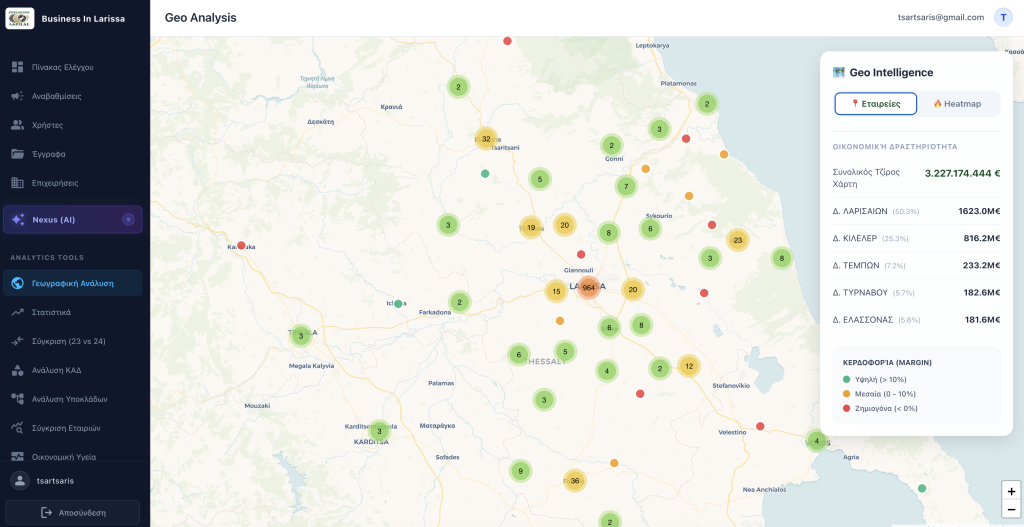
- Geographic analysis: member companies mapped by location across the region
- Trade and export analytics: export declarations broken down by destination country, shipping method, and trade terms, giving the chamber visibility into how member companies move goods internationally
- Custom pivot views: an open-ended analysis table where staff build and save their own cross-sections of the data instead of relying only on preset reports
Built for chamber staff, not just administrators
Access is role-based: admins manage users, uploads, and company records, while other staff can view the analytics without touching sensitive controls. A changelog with in-app notifications keeps the team aware of what’s changed release to release, useful for chamber of commerce software that evolves feature by feature alongside real staff requests rather than shipping as a fixed spec.
Built to scale beyond one chamber
Business in Larissa runs on the same underlying platform architecture we use across our chamber and professional-services deployments, which means the extraction pipeline, access model, and analytics layer aren’t one-off code; they’re patterns we bring to the next regional chamber or business association with the same problem: a lot of valuable member data, trapped in documents, that nobody has had the tooling to actually use.
If your chamber of commerce in Greece is looking at the same pile of unprocessed filings, we’d be glad to show you what this looks like for your registry. We’re continuing to build on this platform, and we’ll be writing about later additions in future posts.
Let’s build something together.
Book a free 30-minute consultation, we’ll discuss your challenges and outline a concrete solution.